
Model details
Railway infrastructure · N 1:160 and H0 1:87 · Development package v0.2
A turntable designed around real model hardware.
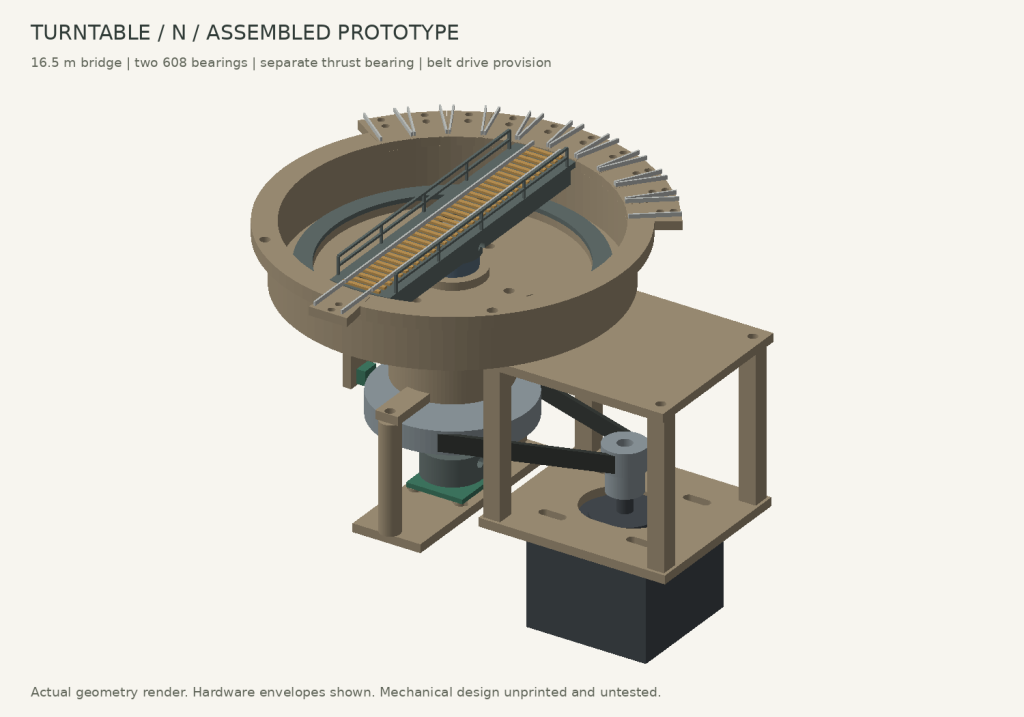
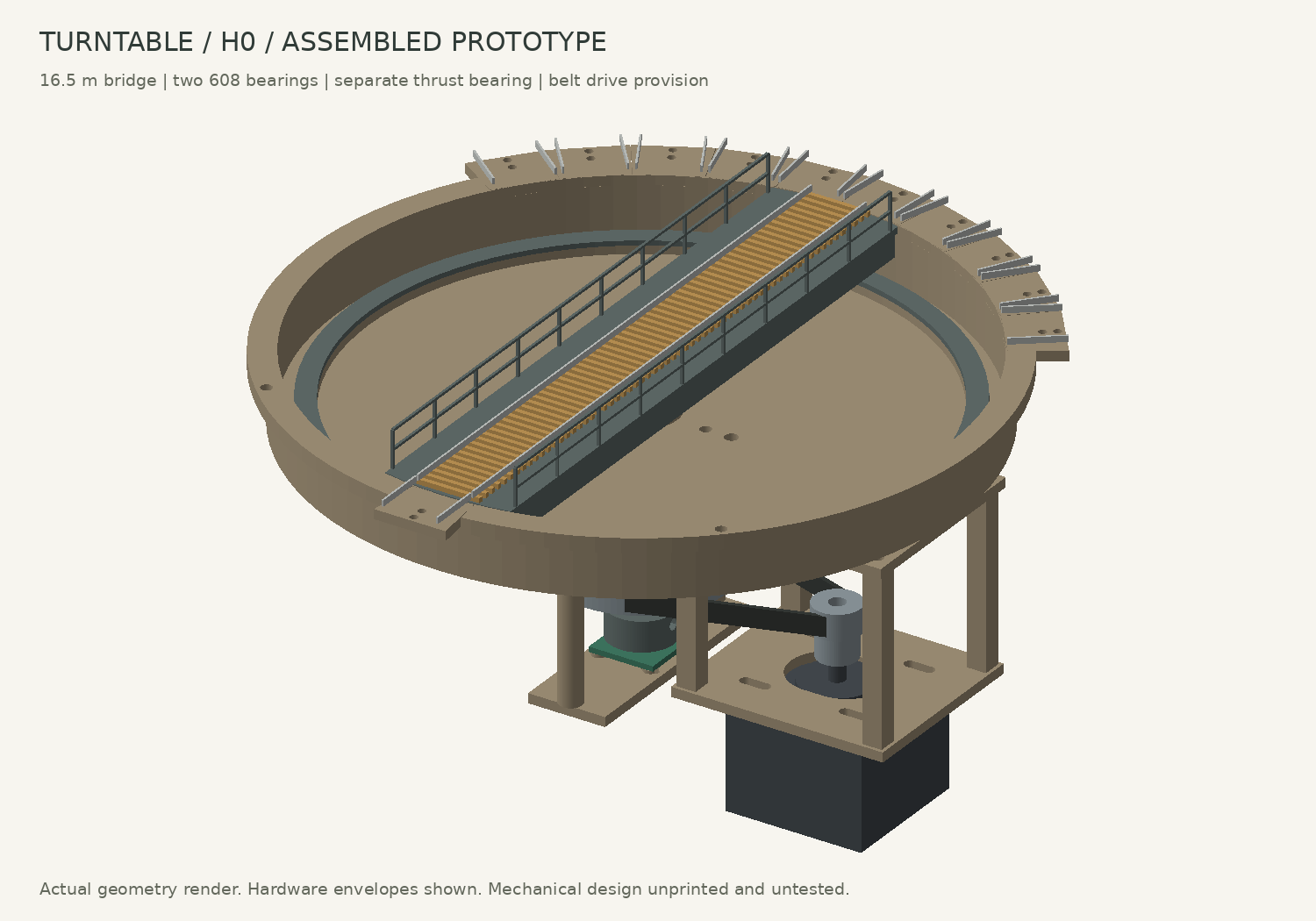
This configurable turntable is a separate mechanical project coordinated with the Probstzella Configurable Roundhouse. Its full-size bridge dimensions and miniature hardware are defined separately, so changing scale does not also shrink the bearings, motor or mounting clearances.
Development preview — not available for purchase. This is an original model-railway mechanism, not a measured reconstruction of Probstzella’s historical mechanism or its larger modern turntable pit.
Two generated scale configurations
The supplied study uses a nominal 16.5-metre bridge: approximately 103.13 mm in N and 189.66 mm in H0. Track gauge is 9 mm and 16.5 mm respectively. Check the intended locomotive’s wheelbase and stopping margin; these dimensions do not guarantee that every locomotive will fit.
Support and automation provisions
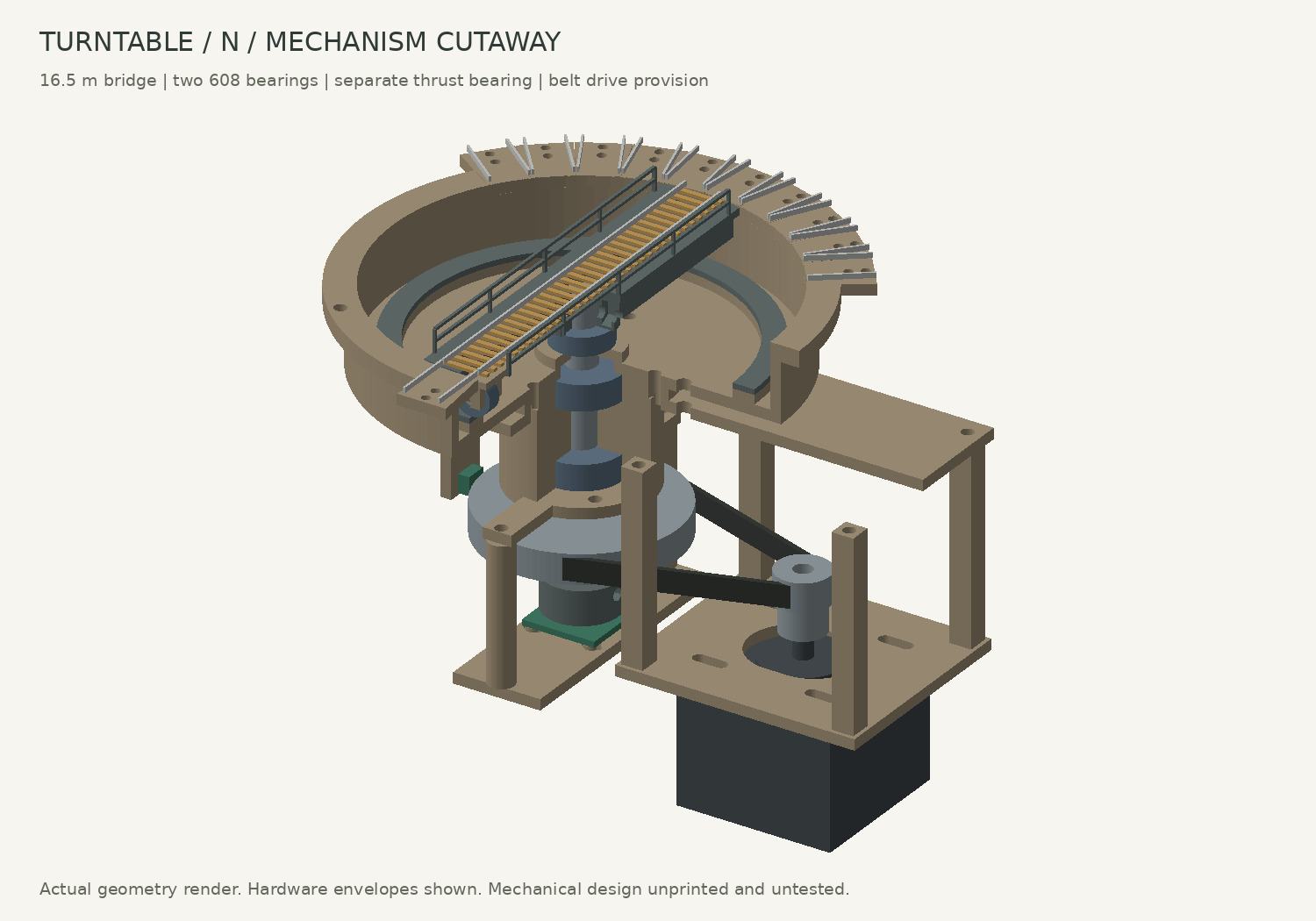
- Two spaced 608 radial bearings guide an 8 mm shaft.
- An F8-16 thrust bearing carries the central vertical load.
- Two 623 end rollers run on a separate race insert to help support the bridge under changing load.
- Separate motor support, belt-drive envelopes and adjustable mounting slots.
- Provision for position and home sensing, with wiring passages and a planned flexible cable loop.
The design aims to limit tilt and vertical movement, but stiffness, loaded alignment, friction and repeatability have not been physically validated. Motor, pulley, sensor-module and fastener choices remain provisional; their CAD envelopes are not a guarantee of compatibility with a particular purchased component.
What the current development package contains
v0.2 retains the v0.1 mechanism geometry and adds an illustrated English assembly guide, numbered diagrams and a parts inventory. There are 21 prototype STL file types per scale; the track receiver is used repeatedly in the supplied layout. Editable Python source, digital assembly views, fit coupons and an offline indexing planner are also included in the development package.
Important operating limits
There is no slip ring, finished controller firmware or proven DCC installation. The current design assumes limited-angle movement rather than unrestricted continuous rotation. Track polarity management, safe alignment detection, cable movement and loaded running tests must be resolved before use.
All displayed views are digital model renders or clearly labelled setting illustrations, not photographs of an operating prototype. Physical printing, slicing and mechanical operation remain untested.